
Vaccination against Lyme disease is crucial.
Product Description
- Up to 73%92 of dogs tested positive for Lyme disease when left unvaccinated
- Prevalence has increased by approximately 250% in north central states93 and more than 320% in northeastern states93
NOBIVAC® LYME
Two inactivated isolates of Borrelia burgdorferi initiate the production of borreliacidal antibodies against OspA and OspC.1,5,80 Shown to be effective against Borrellia burgdorferi and subclinical arthritis caused by Borrelia burgdorferi.
Indications:
Lyme disease is a bacterial infection transmitted by ticks to dogs, other animals and people.
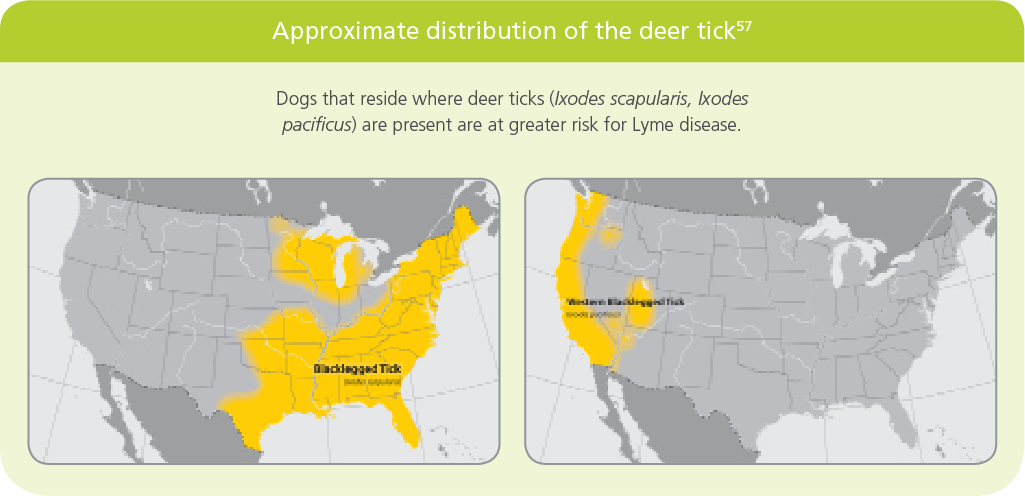
Most Lyme disease in the United States is spread by deer ticks and is found primarily in the Northeast, Southeast and upper Midwest. The western black-legged tick is the primary cause of Lyme disease transmission in the western states.
LYME DISEASE FAST FACTS
- Ticks that can transmit Lyme disease have expanded their geographic range and are now being found in places they weren’t seen 20 years ago82
- The number of counties in the US considered to be high risk for Lyme disease has increased by 320% since the 1990s82
- CAPC data shows nationwide, dogs are being exposed to Lyme disease outside of traditionally endemic areas54
- Approximately 75% of unvaccinated dogs in endemic areas will eventually test positive for Lyme disease55
- The best way to protect dogs is year-round flea and tick control and vaccinating those dogs that visit or live in endemic areas56
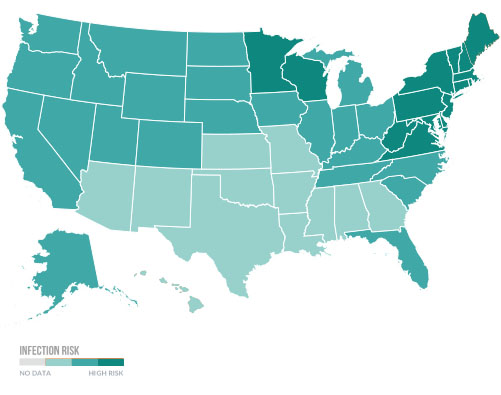
U.S. Canine Lyme Disease Prevalence83
TRANSMISSION
Lyme disease is transmitted by Ixodes spp. ticks, commonly called deer ticks. The ticks carry the bacterial cause of Lyme disease, Borrelia burgdorferi. After attaching to a dog, a tick takes a blood meal which stimulates the B. burgdorferi in the midgut of the tick to change their outer surface protein from Osp A (outer surface protein A) to Osp C. This outer surface protein change enables the bacterium to move into the tick’s salivary glands where it can be injected into the dog’s bloodstream. Once in the bloodstream the organism is carried to multiple locations including the joints.
CLINICAL SIGNS
- Arthritis
- Lameness
- Fever
- Anorexia
- Fatigue
DOGS AT RISK
- Lyme disease was traditionally thought to be limited primarily to the Northeastern region of the U.S. where deer populations were most dense. However, the warming weather and migration of the white-tail deer have caused the spread of the tick populations. Because of this, Lyme disease is now prevalent in the majority of the U.S., increasing the number of dogs at risk.
- With the increase in dog travel to Lyme endemic areas, more dogs are at risk. Positive cases of canine Lyme disease have been reported across the U.S., with 39 states now reporting high and moderately high prevalence of canine Lyme disease.83
- Dogs at increased risk for Lyme disease include:
- Active dogs that walk or hike in the woods
- Dogs that play in fields
- Dogs that spend time in the yard
MORBIDITY THREATS
Most commonly, dogs may present with fever, shifting leg lameness, swollen joints, enlarged lymph nodes, lethargy, depression and anorexia.
Less commonly, dogs will develop a protein losing nephropathy that can result in hypoalbuminemia, edema and eventually renal failure, which is known as Lyme nephritis.
SPREADING DISEASE
- Infection occurs 24-48 hours after the tick attaches to a host when
B. burgdoeri is passed through the salivary glands of an infected tick into the animal.84 - Once the animal is infected with spirochetes from the tick, the spirochetes spread through connective tissue and may result in infections in the joints, heart, and neural tissue.84
DIAGNOSIS
Diagnosis is based on history, clinical signs, elimination of other diagnoses, laboratory data, epidemiologic considerations, and response to antibiotic therapy. Mixed infections should be considered when clinical signs are apparent.
Long incubation periods, persistence of antibodies for months to years, and the disassociation of the antibody response from the clinical stage of disease make diagnosis by blood testing alone impossible.
Professional Resources and Educational Materials
Keep your clinic and staff informed and aware of diseases and outbreaks.
View More Nobivac® ResourcesBrochure
Lyme Disease Pet Parent Guide
Printable brochure to educate pet parents about their dog’s risk for Canine Lyme Disease. What is Lyme disease? What are the signs of Lyme disease? How serious is Lyme disease?
TECHNICAL ASSISTANCE
For technical assistance or to report a suspected adverse drug reaction, contact Merck Animal Health at 1-800-224-5318
References






 Go To United States
 Algeria
 Argentina
 Australia
 Austria
 Bahrain
 Belgium (Dutch)
 Brazil
 Canada (English)
 Chile
Chile Colombia
 Croatia
 Czech Republic
 Denmark
 Ecuador
 Egypt
Egypt Finland
 France
 Germany
 Greece
 Hungary
 India
India Indonesia
 Iraq
Iraq Ireland
 Israel
 Italy
Italy Japan
Japan Jordan
 Kuwait
 Lebanon
 Malaysia
 Mexico
 Morocco
 Netherlands
 New Zealand
 Norway
 Oman
Oman Panama
 Peru
Peru Philippines
 Poland
 Portugal
 Qatar
Qatar Romania
 Russian Federation
 Saudi Arabia
 South Africa
 South Korea
 Spain
Spain Sweden
 Switzerland (French)
 Taiwan
 Thailand
 Tunisia
 Turkey
 Ukraine
 United Arab Emirates
 United Kingdom
 Uruguay
 Yemen
Yemen Global